
 2 years ago
124
Israel’s order for civilians to “immediately” evacuate parts of Rafah poses severe humanitarian and logistical challenges in the southern Gazan city, where over 1 million displaced people have sought refuge since war broke out in the enclave seven months ago.
On Monday, the Israel Defense Forces told about 100,000 civilians in Rafah to evacuate to a humanitarian zone in the territory’s west, saying the military would operate with “extreme force” in the areas where they live.
Since the war began, Israel has conducted ground operations across most of Gaza, steadily pushing Palestinians south. The United Nations estimates up to 1.7 million people have been displaced by the conflict. A majority of them are in Rafah, which before the war had a population of around 275,000.
Civilians in Shouka and the eastern Rafah neighborhoods of Salam, Jeneina, Tabet Ziraa and Byouk were told to leave for an encampment in the Mawasi area, on the outskirts of Khan Younis, according to a statement in Arabic from Lt. Col. Avichay Adraee, an IDF spokesman.
Rafah residents were informed through fliers dropped from the air and via messages, phone calls and broadcasts in Arabic, the IDF said.
Palestinian families were seen leaving areas of Rafah on May 6 after receiving orders from Israel to evacuate immediately. (Video: Reuters)
Mawasi has for some time now been deemed a safe zone in the war. Satellite imagery last month showed a growing encampment in the area. But aid groups have warned that the area has little infrastructure to sustain the increasing population of refugees.
“Even before today’s evacuation orders, Al-Mawasi was uninhabitable,” said Tjada D’Oyen McKenna, chief executive of Mercy Corps, in a statement. “Our team members report tents stretched endlessly under scorching sun with no relief in sight and no electricity, water, or aid.”
Deir al-Balah and Khan Younis were also deemed part of what the IDF called an expanded humanitarian zone. Both places have seen fighting and destruction during the war, making them hard to access for aid deliveries or evacuations.
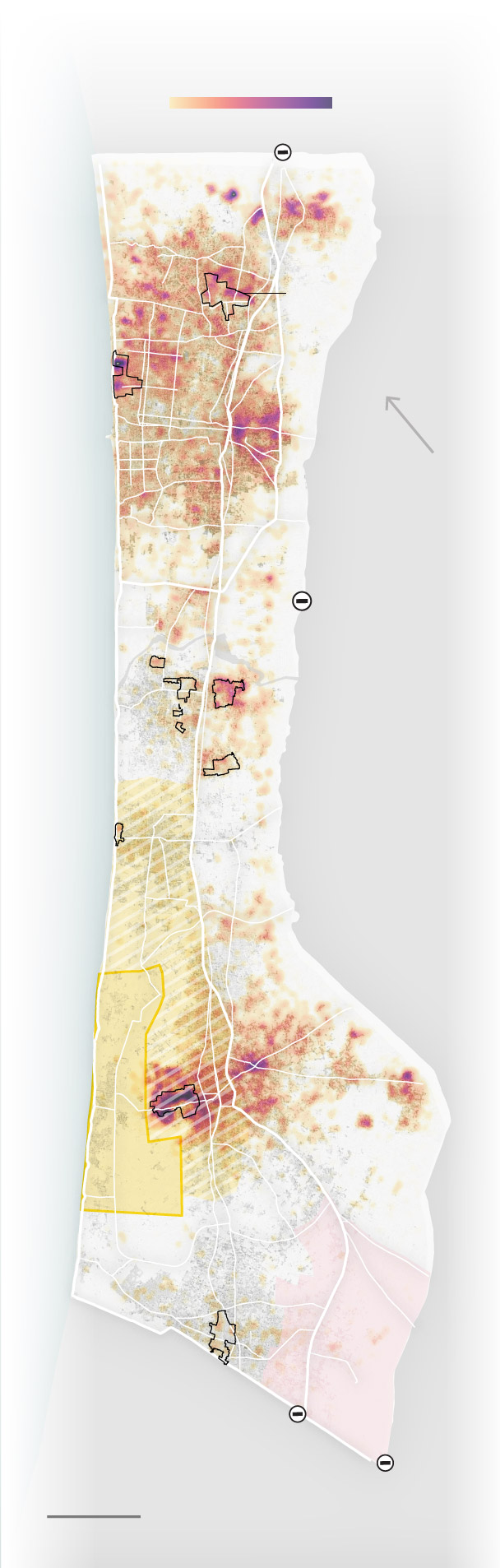
Density of damage based
on satellite imagery
as of Feb. 29
Moderate
Destroyed
Erez crossing
Beit Lahiya
Jabalya camp
Jabalya
NORTH
ISRAEL
Gate 96:
Israeli controlled
entry point for aid
IDF expanded
humanitarian
zone
Al Qarara
IDF
designated
humanitarian
zone
Mawasi
Rafah
EGYPT
Kerem Shalom
commercial crossing
2 MILES
Sources: IDF, UN OCHA and IMPACT/UNOSAT

Density of damage based on satellite imagery
as of Feb. 29
Moderate
Destroyed
Erez crossing
NORTH
Beit Lahiya
Jabalya camp
Jabalya
ISRAEL
Gate 96:
Israeli controlled
entry point for aid
2 MILES
IDF expanded
humanitarian
zone
Al Qarara
IDF designated
humanitarian
zone
Mawasi
Rafah
ISRAEL
Rafah camp
EGYPT
Kerem Shalom
commercial
crossing
Sources: IDF, UN OCHA and IMPACT/UNOSAT

Density of damage based on satellite imagery
as of Feb. 29
Moderate
Destroyed
Erez crossing
Beit Hanoun
Beit Lahiya
NORTH
Jabalya camp
Jabalya
ISRAEL
Gate 96:
Israeli controlled
entry point for aid
ISRAEL
IDF expanded
humanitarian
zone
Qarrara
IDF designated
humanitarian
zone
Mawasi
Rafah
Rafah camp
2 MILES
2 KM
EGYPT
Sources: UN OCHA,
IMPACT/UNOSAT and
OpenStreetMap
Kerem Shalom
commercial crossing
The red zone — the focus of Israel’s new operation — includes Al-Najjar hospital, which provides limited treatment for cancer, dialysis, pediatrics and emergency care.
Mhoira Leng, a palliative care provider who recently returned from volunteering at the hospital said in a statement that patients and workers there were already struggling to receive care. “The staff are living in tents with scarce access to food. Now, they are being forced to flee and move immovable patients out of the only hospital providing this care in Gaza.”
The zone also includes two major entry points for aid into Gaza: Rafah crossing and Kerem Shalom crossing. Aid groups warned that this could be disastrous for the humanitarian efforts in the enclave.
“Rafah is currently the central hub of all humanitarian operations and a lifeline for aid to enter Gaza,” McKenna said. “An offensive will cause the humanitarian response — already impeded by extremely limited access, onerous border checks, and the destruction of vital infrastructure from roads to warehouses — to collapse.”
The zone also encompasses a large segment of Rafah’s agricultural land. Fighting there could further hamper Gaza’s ability to produce its own food.

1 MILE
Maternity Hospital
Rafah
al-Najjar Hospital
Kuwait Hospital
al-Buyuki
EVACUATION ZONE
al-Bayuk
EGYPT
GAZA
ISRAEL
Satelitte image via Planet Labs PBC

1 MILE
Maternity Hospital
Rafah
al-Najjar Hospital
Kuwait Hospital
al-Buyuki
EVACUATION ZONE
al-Bayuk
EGYPT
GAZA
ISRAEL
Satelitte image via Planet Labs PBC

1 MILE
Tal al-Sultan camp
al-Helal al-Emirati Maternity Hospital
Umm al-Kameil
al-Najjar Hospital
Umm al-Kilab
Kuwait Hospital
Rafah
Rafah camp
al-Buyuki
Salah al-Din Road
al-Najarr Hospital
EVACUATION ZONE
EGYPT
al Bayuk
GAZA
ISRAEL
Gaza International Airport
(Closed since 2002)
Satelitte image via Planet Labs PBC

1 MILE
Tal al-Sultan camp
al-Helal al-Emirati Maternity Hospital
European Hospital
Umm al-Kameil
al-Najjar Hospital
Umm al-Kilab
Kuwait Hospital
Rafah
Rafah camp
al-Buyuki
Salah al-Din Road
al-Najarr Hospital
EVACUATION ZONE
Salah al-Din Road
al-Bayuk
EGYPT
GAZA
ISRAEL
Gaza International Airport
(Closed since 2002)
Niha Masih, Lior Soroka, Annabelle Timsit and Cate Brown contributed to this report.
Israel-Gaza war
The Israel-Gaza war has gone on for six months, and tensions have spilled into the surrounding region.
The war: On Oct. 7, Hamas militants launched an unprecedented cross-border attack on Israel that included the taking of civilian hostages at a music festival. (See photos and videos of how the deadly assault unfolded). Israel declared war on Hamas in response, launching a ground invasion that fueled the biggest displacement in the region since Israel’s creation in 1948.
Gaza crisis: In the Gaza Strip, Israel has waged one of this century’s most destructive wars, killing tens of thousands and plunging at least half of the population into “famine-like conditions.” For months, Israel has resisted pressure from Western allies to allow more humanitarian aid into the enclave.
U.S. involvement: Despite tensions between Israeli Prime Minister Benjamin Netanyahu and some U.S. politicians, including President Biden, the United States supports Israel with weapons, funds aid packages, and has vetoed or abstained from the United Nations’ cease-fire resolutions.
History: The roots of the Israeli-Palestinian conflict and mistrust are deep and complex, predating the establishment of the state of Israel in 1948. Read more on the history of the Gaza Strip.



 English (US)